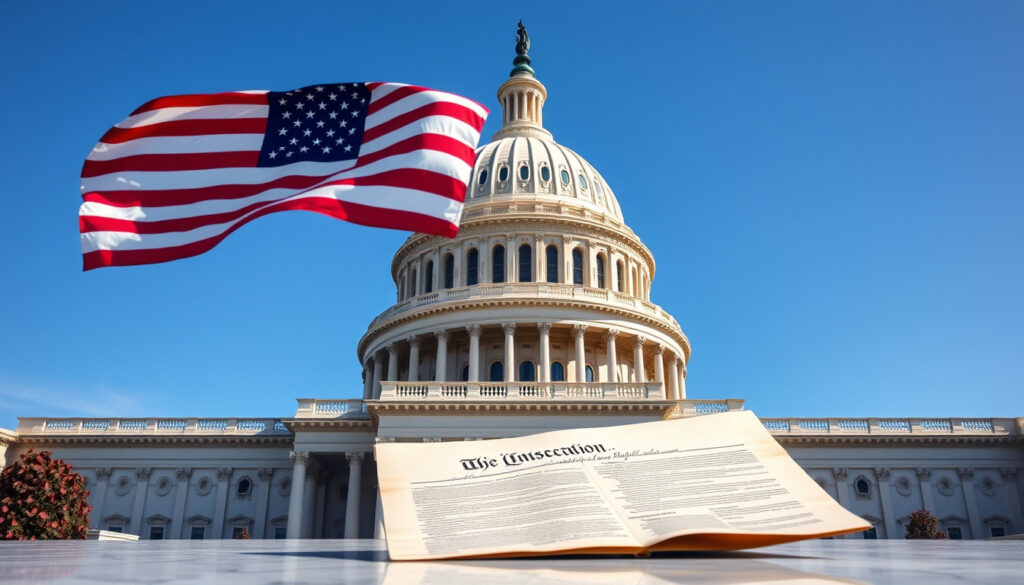
What Type of Government Is the US? Constitutional Republic Explained
If you’ve ever heard someone call the United States a democracy and someone else correct them mid-sentence — you’re not alone. The distinction between a “democracy” and a “constitutional federal republic” trips people up all the time. Here’s the real answer, backed by official sources: the US is a constitutional federal republic, not a pure democracy, and that difference shapes how your government actually works. Below is a plain-language guide to what that means, who holds power, and how the three branches interact.
Form of Government: Constitutional Federal Republic · Number of Branches: 3 (Legislative, Executive, Judicial) · Constitutional Basis: U.S. Constitution (1787) · Head of State: President · Legislature: Bicameral Congress
Quick snapshot
- The US government is a constitutional federal republic, according to the U.S. Embassy
- It has three separate but equal branches per the U.S. Courts
- Whether popular “democracy” label reflects public understanding or political rhetoric
- How much ordinary voters understand the republic vs. democracy distinction
- Constitution ratified in 1788 — continuous effect since March 4, 1789 per U.S. Embassy publication and historical records
- Structural framework unchanged for over 235 years (U.S. Embassy publication)
- Understanding the republic concept helps voters engage more critically with their government per ASU civic literacy resources
| Label | Value |
|---|---|
| Government Type | Constitutional Federal Republic |
| Founding Document | U.S. Constitution (1787) |
| Branches | 3 |
| President Term | 4 years |
| Congress Terms | House: 2 years; Senate: 6 years |
What type of government are we in the United States?
The United States government is officially classified as a constitutional federal republic. This term appears directly on official U.S. government websites, including the U.S. Embassy publication on how the United States is governed. “Constitutional” means the government operates within the framework of the supreme law — the U.S. Constitution — which explicitly limits what the government can do. “Federal” means power is shared between the national government and individual states. “Republic” means citizens elect representatives to exercise power rather than ruling directly.
Constitutional federal republic definition
A constitutional federal republic is a system where elected representatives govern within boundaries set by a constitution. The founders designed this structure after the Constitutional Convention of 1787 specifically to strike a balance: enough national power to function effectively, but enough limits to protect individual rights. The White House notes the Constitution was created with a clear aim — “to create a government with enough power to act on a national level, but without so much power that fundamental rights would be at risk.”
Distinction from pure democracy
The difference matters: pure democracy operates on direct majority rule, where citizens vote on every issue. There’s no constitution limiting what the majority can decide. In a constitutional republic, elected representatives make decisions on your behalf — but those decisions must fall within the boundaries the Constitution sets. EBSCO Research Starters explains that in a constitutional republic, government power is divided into three branches with defined powers and limits.
A pure democracy would let 51% of voters strip minority rights at any time. The republic’s constitutional limits exist precisely to prevent that — protecting free speech, religious freedom, and other rights even when a majority disagrees.
Is the government of the U.S. a democracy?
It’s accurate to say the United States has democratic elements — citizens vote for representatives, elections are held, and those representatives respond to public opinion. But calling the US a “pure democracy” is technically imprecise. The U.S. Embassy puts it bluntly: “While often categorized as a democracy, the United States is more accurately defined as a constitutional federal republic.” The key distinction lies in the constitutional framework that limits what elected majorities can do.
Representative democracy elements
The US does incorporate representative democracy — citizens elect officials (president, congresspeople, senators, state legislators) who then make laws and decisions on their behalf. This is the “representative” part of the “representative democracy” label you sometimes hear. Wikipedia’s overview of the federal government notes the US is “often called democratic republic, representative democracy, or constitutional republic” — all of which capture something true about the system.
Republic safeguards
The “republic” part guarantees that constitutional limits stay in place regardless of what voters want. Congress can’t pass a law eliminating the First Amendment, even if 70% of Americans supported it. The Supreme Court can strike down such laws as unconstitutional. These safeguards exist because the founders feared what the White House describes as the experience with “the King of England and Parliament” — concentrated power without accountability or limits. Your constitutional rights aren’t subject to popular vote.
When you hear politicians or commentators call the US a “democracy,” they’re using a shorthand that glosses over the constitutional safeguards that actually protect your rights. Understanding the distinction helps you evaluate claims about how the system works — and whether proposed changes preserve or undermine those safeguards.
What is the government called in the USA?
The official name is the federal government of the United States, commonly shortened to the “U.S. government” or “federal government.” The White House describes it as “composed of three distinct branches: legislative, executive, and judicial, whose powers are vested by the U.S. Constitution.” This tripartite structure is the defining feature of American governance.
Federal government overview
The federal government operates under the Constitution ratified in 1788 and in continuous effect since March 4, 1789. Its powers are enumerated (listed) in the Constitution — everything else falls to the states or the people. USAGov explains that the three branches “ensure no individual or group has too much power” through a system of checks and balances.
Official terminology
The terms “constitutional federal republic,” “federal republic,” and “representative democracy” are all used — sometimes interchangeably — to describe the US system. ASU’s civic literacy resources describe the US as “a federal republic with limited central powers and self-governing states.” The term you encounter most often in official documents is “constitutional federal republic.”
What form of government is the United States ruled by?
The United States is ruled by a constitutional federal republic operating under the separation of powers doctrine. The Constitution divides government into three branches — legislative, executive, and judicial — each with distinct roles. The Constitution Center notes that “Article I describes the legislative branch, Article II the executive branch, and Article III the judicial branch.” No branch can function without the others, and each can check the others’ power.
Under the Constitution
The Constitution is supreme law. Federal powers are enumerated in it; powers not granted to the federal government are reserved to states and the people. The White House emphasizes that the Constitution “provides the framework for the federal government” and “sets clear limits on the power of the federal government to protect the rights of individuals and states.”
Key structural features
The structural features that define how the US is ruled include bicameral Congress (House and Senate), a presidential system (not parliamentary), an appointed lifetime Supreme Court, federalism dividing power between national and state governments, and the Electoral College for presidential selection. The Truman Library provides the composition numbers: Congress has 100 senators (2 per state) and 435 representatives (apportioned by population).
Who holds the real power in the United States?
Power in the US government is distributed — intentionally — so that no single person, branch, or institution holds all the power. USAGov states this plainly: “The three branches ensure no individual or group has too much power through checks and balances.” Understanding who holds what requires looking at each branch.
Division of powers
The three branches hold distinct powers: Congress (legislative) makes laws, the President (executive) enforces them, and the federal courts (judicial) interprets them. But each branch can check the others. The U.S. Courts explain that “the Constitution establishes three separate but equal branches of government” to prevent any one from becoming too powerful.
Branches and their roles
The legislative branch (Congress) introduces and passes laws. The executive branch (President and federal agencies) implements and enforces laws. The judicial branch (Supreme Court and lower federal courts) interprets laws and can strike down those found unconstitutional. USAGov details the checks: “The President can veto legislation, Congress confirms nominees and can override vetoes with a two-thirds vote, and the Supreme Court can overturn laws deemed unconstitutional.”
For voters, this means your power flows through elected representatives — but those representatives operate within constitutional constraints. The President can’t unilaterally pass laws, Congress can’t override constitutional rights, and the Supreme Court can’t legislate. Each actor has a defined lane.
Upsides
- Constitutional rights protected even against majority will
- Checks and balances prevent branch tyranny
- Federalism lets states experiment with different policies
- Elected representatives deliberate rather than react to momentary impulses
Downsides
- Decision-making can be slow and contentious
- Gridlock occurs when branches disagree
- Constitutional amendments are extremely difficult to pass
- Citizens have less direct control than in pure democracy
The White House (Official U.S. Government)
“The Federal Government is composed of three distinct branches: legislative, executive, and judicial, whose powers are vested by the US Constitution.”
U.S. Embassy (Official U.S. Government)
“While often categorized as a democracy, the United States is more accurately defined as a constitutional federal republic.”
Congress.gov (Primary Constitutional Source)
“The United States shall guarantee to every State in this Union a Republican Form of Government.”
Related reading: Pentagon Texas Border Buffer Zone – Facts Timeline Legal Details · Older Drivers License Changes US 2025 – What Seniors Need to Know
The US constitutional republic divides authority among the three branches of government, each wielding distinct powers with built-in checks and balances.
Frequently asked questions
What are the three types of democracy?
The three main types discussed in political science are direct democracy (citizens vote on laws themselves), representative democracy (citizens elect representatives to make decisions), and participatory democracy (citizens actively engage in policy-making beyond voting). The US combines elements of representative democracy with constitutional republican structures — the elected branches make decisions, but those decisions must conform to constitutional limits.
What type of government is the USA right now?
The United States is currently a constitutional federal republic in continuous operation under the original Constitution since March 4, 1789. The structural framework — three branches, federalism, separation of powers — remains unchanged from the founding document, though interpretations evolve through court rulings and constitutional amendments.
What are the 3 branches of government and their functions?
The legislative branch (Congress: House and Senate) drafts and passes federal laws. The executive branch (President, Vice President, Cabinet, federal agencies) enforces laws. The judicial branch (Supreme Court, federal courts) interprets laws and evaluates their constitutionality. Each branch can check the others’ powers to maintain balance.
Who can invoke the 25th Amendment against the president?
The 25th Amendment covers presidential succession and disability. Section 4 allows the Vice President, together with a majority of principal officers of the executive departments, to declare the President unable to discharge duties. This has never been formally invoked but provides the constitutional mechanism for addressing presidential incapacity.
Is the US government capitalist?
The Constitution doesn’t designate an economic system; it establishes a governmental structure. The US operates a market economy with capitalist elements, but this is a policy choice, not a constitutional requirement. The government’s role in the economy has varied throughout history based on laws passed by Congress and interpreted by courts.
What is the U.S. government website?
The official federal government portal is USA.gov. Official sources for this article include the White House (whitehouse.gov), USAGov (usa.gov/branches-of-government), Congress.gov, USCourts.gov, and the U.S. Embassy’s published guides.
What is a U.S. Government structure chart?
A U.S. Government structure chart visually depicts the three branches, their components, and relationships. The legislative branch includes Congress (Senate and House), the executive includes the President and federal agencies, and the judicial includes the Supreme Court and federal circuit/district courts. State governments mirror this structure but aren’t constitutionally required to do so.
What does Article IV Section 4 guarantee?
Article IV, Section 4 of the Constitution “guarantees to every State in this Union a Republican Form of Government.” This means every state must maintain a representative system where citizens elect officials and those officials govern through representative bodies — not monarchy, theocracy, or pure autocracy. Congress.gov provides the primary text.
For Americans who want to engage critically with their government, the constitutional republic framework offers a clearer lens than “democracy” ever could. The founders built a system specifically designed to prevent 51% of voters from steamrolling minority rights — that structural choice still protects you today. The question isn’t whether the US government is democratic enough; it’s whether Americans understand the republican safeguards that make it work.
More related posts
 San Jose State University: Rankings, Cost, Admission & FAQ
 When Was Roe v. Wade Overturned? Date and Vote
 What Is a Good Credit Score to Buy a Car With No Down Payment?
 Interlock Device Near Me: Find Installation & Compare Costs
 Apartments Near Me for Rent 2025: Dublin Guide & Prices
 What Is a Cold Sore? Causes, Transmission, and Treatment
 Bed Bug Bite Symptoms: Identification and Treatment Guide
 Best Meal Delivery Service 2026: Top-Rated and Tested
