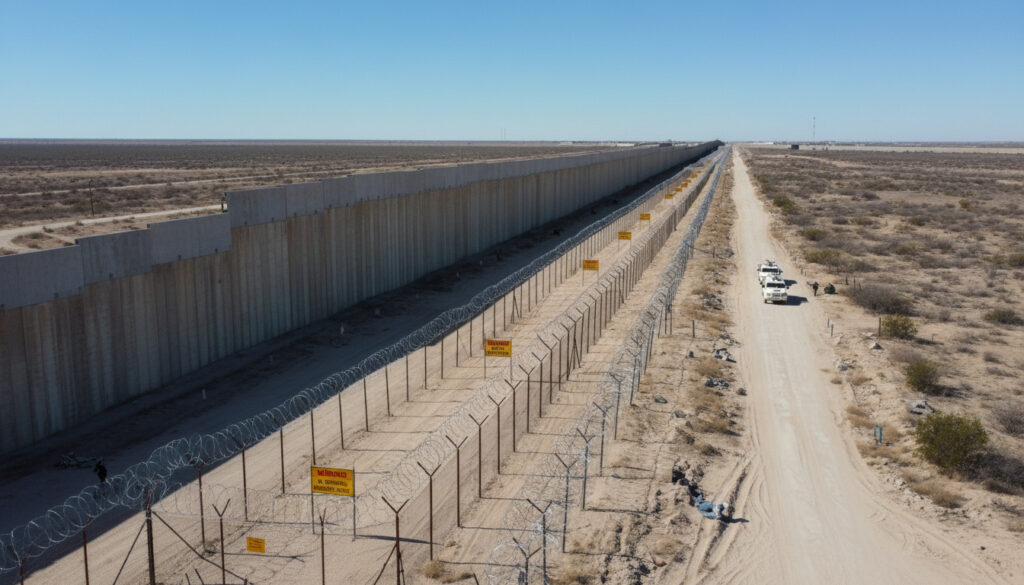
Pentagon Texas Border Buffer Zone – Facts Timeline Legal Details
The Pentagon announced on June 25-26, 2025, the establishment of a new 250-mile National Defense Area (NDA) military buffer zone along the Texas-Mexico border in Cameron and Hidalgo counties, spanning the Rio Grande River. This designation transfers jurisdiction from the International Boundary and Water Commission to the Department of Defense, specifically administering the territory under Joint Base San Antonio as part of broader border security efforts.
The creation of this buffer zone represents the third major expansion of military-controlled border territories since April 2025, bringing total National Defense Area coverage along the Texas-Mexico border to between 480 and 583 miles. Officials cite the initiative as part of broader efforts to address border security amid historically low crossing attempts, with apprehensions dropping to 5,414 between June 1-22, 2025, and “gotaways” numbering 986.
Operations fall under the Joint Task Force-Southern Border commanded by U.S. Northern Command (NORTHCOM), with support from the Air Force and Marine Corps overseeing attached installations. The designation raises significant questions regarding military authority limits, subsequent legal challenges, and the practical impact on immigration enforcement while aligning with Trump administration efforts to treat border sealing as a military mission.
What Is the Pentagon Texas Border Buffer Zone?
June 25-26, 2025
Enhance detection, monitoring, patrols, and temporary barriers
250 miles along Rio Grande in Cameron and Hidalgo counties
Joint Task Force-Southern Border, NORTHCOM, Joint Base San Antonio
- The zone covers 250 miles of the Rio Grande River in South Texas, transferred from the International Boundary and Water Commission.
- Four National Defense Areas now total 480-583 miles of coverage along the 1,254-mile Texas-Mexico border.
- Military personnel may temporarily detain trespassers for transfer to U.S. Customs and Border Protection but cannot perform direct law enforcement.
- The area operates as an extension of Joint Base San Antonio under Joint Task Force-Southern Border.
- Officials state the designation aims to deter illegal crossings through enhanced monitoring and physical barriers.
- The initiative aligns with Trump administration efforts to seal the border as a military mission.
- A federal magistrate judge recently dismissed trespassing charges against migrants arrested in the New Mexico NDA due to signage and terrain issues.
| Fact | Details | Source Type |
|---|---|---|
| Announcement Date | June 25-26, 2025 | News Report |
| Geographic Location | Cameron and Hidalgo counties, Texas | Government/News |
| Zone Length | 250 miles | News Report |
| Administrative Control | Joint Base San Antonio | News Report |
| Operational Command | Joint Task Force-Southern Border (NORTHCOM) | News Report |
| Legal Designation | National Defense Area | Government/News |
| Detention Authority | Temporary only; transfer to CBP required | Legal/News |
| Previous Zones | 170 miles (NM), 63 miles (West TX) | News Report |
| Apprehension Data | 5,414 (June 1-22, 2025); 986 gotaways | Government/News |
| Judicial Action | 98 migrants’ charges dismissed (NM zone) | Legal/News |
How Does the Military Buffer Zone Operate?
Command Structure and Oversight
The buffer zone operates under the Joint Task Force-Southern Border, commanded by U.S. Northern Command (NORTHCOM). This task force coordinates detection, monitoring, patrols, and the installation of temporary barriers and signage. The Air Force and Marine Corps oversee attached installations, with the 250-mile Texas zone administered through Joint Base San Antonio and the 100-mile Arizona zone falling under Marine Corps Air Station Yuma.
Operational Capabilities and Constraints
Military personnel within the NDA support interagency coordination but do not perform civilian law enforcement functions. They maintain authority to temporarily detain trespassers, including undocumented migrants, treating the area as an extension of a military base. Detainees must be transferred to U.S. Customs and Border Protection; military personnel cannot conduct arrests, prosecutions, or other direct law enforcement activities.
Military personnel within National Defense Areas may temporarily detain trespassers for transfer to U.S. Customs and Border Protection. They cannot perform civilian law enforcement functions such as arrests or prosecutions under the Posse Comitatus Act restrictions.
What Legal Authority Governs the Border Buffer Zone?
Exceptions to the Posse Comitatus Act
National Defense Areas grant the military limited authority under specific exceptions to the Posse Comitatus Act. This legal framework permits temporary detention, brief searches, installation of barriers, and patrols without constituting direct law enforcement. The land transfer from the International Boundary and Water Commission to the Department of Defense enables this base-extension status, creating jurisdiction distinct from standard border patrol operations.
Judicial Scrutiny and Recent Rulings
The legal framework faces active challenges in federal court. Federal Magistrate Judge Gregory Wormuth dismissed trespassing charges against 98 migrants arrested in the New Mexico NDA last month, ruling the government failed to prove the defendants knew they entered a restricted zone. The court cited terrain difficulties and inadequate signage as factors preventing reasonable notice of the military jurisdiction.
Which Military Installations Administer the Zones?
The Pentagon has established four distinct National Defense Areas along the southern border since April 2025. The Air Force oversees operations attached to Fort Huachuca in Arizona (170 miles in New Mexico) and Fort Bliss in West Texas (63 miles), while the Marine Corps manages the 100-mile zone in western Arizona under Marine Corps Air Station Yuma, pending formal confirmation.
The establishment of these buffer zones required land transfers from the International Boundary and Water Commission to the Department of Defense, effectively designating these strips as extensions of existing military installations rather than civilian border territory.
While the Pentagon announced the 100-mile Arizona National Defense Area for Marine Corps Air Station Yuma on June 25-26, 2025, formal Marine Corps confirmation of this specific zone remains pending according to available reports.
When Were the National Defense Areas Established?
- April 2025: First NDA established—170 miles in New Mexico, attached to Fort Huachuca, Arizona.
- May 2025: Second NDA established—63 miles in West Texas, attached to Fort Bliss.
- June 25-26, 2025: Pentagon announces two new NDAs—250 miles in South Texas (Rio Grande, Cameron/Hidalgo counties, under Joint Base San Antonio) and 100 miles in western Arizona (under Marine Corps Air Station Yuma).
What Has Been Confirmed and What Remains Unclear?
| Established Information | Information That Remains Unclear |
|---|---|
| The 250-mile Texas zone was announced June 25-26, 2025 | Specific National Guard deployment details and numbers |
| Location covers Cameron and Hidalgo counties along the Rio Grande | Official statements from Texas Governor Greg Abbott |
| Operated by Joint Task Force-Southern Border under NORTHCOM | Concrete plans for expansion beyond the four existing zones |
| Total NDA coverage exceeds 480-583 miles | Formal Marine Corps confirmation of the Arizona zone |
| Federal judge dismissed charges against 98 migrants in NM zone | Long-term funding and permanence of the temporary barriers |
How Does This Fit Into Broader Border Security Policy?
The National Defense Areas represent a strategic shift toward Department of Defense-led homeland defense, treating territorial integrity as a military mission rather than solely a law enforcement matter. These designations coincide with record-low border crossing numbers, suggesting the policy serves deterrence and infrastructure purposes alongside immediate interdiction needs. The approach reflects the Trump administration’s broader efforts to militarize border security through existing statutory authorities rather than new legislative action.
The zones operate within a complex legal environment where military jurisdiction overlaps with civilian immigration enforcement, creating novel questions about due process, notice requirements, and the limits of military authority in domestic spaces. As courts continue evaluating the validity of arrests made within these zones, the practical implementation faces ongoing refinement regarding signage, terrain assessment, and coordination with civilian agencies.
Similar to how Floyd Roger Myers Jr – Rachel Morin Murder Suspect Details highlighted specific enforcement challenges in border-adjacent jurisdictions, these military zones attempt to preempt security threats through presence and deterrence rather than reactive policing. The Pentagon’s Texas border buffer zone, which attempts to preempt security threats through presence and deterrence, can be further understood by visiting $convert Word to PDF.
What Have Courts and Officials Determined?
Federal judicial oversight has already tested the practical application of National Defense Area authority. In the most significant ruling to date, a federal magistrate addressed the fundamental question of whether migrants could reasonably know they had entered restricted military territory.
The government failed to prove they knew they entered a restricted zone due to terrain and signage issues.
— Federal Magistrate Judge Gregory Wormuth, regarding 98 migrants arrested in the New Mexico NDA, May/June 2025
No official statements from Texas Governor Greg Abbott appear in available records regarding the establishment of the 250-mile buffer zone. Similarly, specific National Guard deployment figures and roles remain unspecified in public Pentagon announcements, with operations falling entirely under active-duty military command structures rather than state National Guard chains of command.
What Are the Essential Facts About the Buffer Zone?
The Pentagon’s 250-mile Texas border buffer zone represents an unprecedented expansion of military jurisdiction along the Rio Grande, established through National Defense Area designations that treat the territory as extensions of existing bases. While military personnel may temporarily detain individuals for civilian law enforcement transfer, they lack arrest authority, and recent court rulings have challenged the government’s ability to prosecute trespassing without clear signage and terrain marking. The initiative operates alongside How Long Can A Human Go Without Eating – Survival Timeline other national security priorities, though significant questions remain regarding future expansions, specific National Guard involvement, and the resolution of legal challenges to the zones’ jurisdictional validity.
Frequently Asked Questions
What is a National Defense Area?
A National Defense Area is a designated geographic zone transferred to military jurisdiction, treated legally as an extension of a military base. This designation allows limited military authority for security purposes while restricting civilian law enforcement powers under the Posse Comitatus Act.
Can military personnel arrest migrants in the buffer zone?
No. Military personnel cannot perform civilian law enforcement arrests. They may temporarily detain trespassers, including undocumented migrants, but must immediately transfer them to U.S. Customs and Border Protection for processing and legal action.
How large is the Texas buffer zone?
The Texas buffer zone spans 250 miles along the Rio Grande River, covering Cameron and Hidalgo counties in South Texas. Combined with previous designations, total National Defense Area coverage along the Texas-Mexico border exceeds 480 miles.
What happens to people detained in the NDA?
Individuals detained within the National Defense Area are held temporarily by military personnel and then transferred to U.S. Customs and Border Protection. The military does not maintain detention facilities or conduct legal processing for immigration violations.
Are there similar zones in other states?
Yes. Similar National Defense Areas include 170 miles in New Mexico attached to Fort Huachuca, 63 miles in West Texas attached to Fort Bliss, and a pending 100-mile zone in western Arizona under Marine Corps Air Station Yuma.
What legal challenges have emerged?
Federal Magistrate Judge Gregory Wormuth dismissed trespassing charges against 98 migrants in May/June 2025, ruling inadequate signage and terrain features prevented reasonable knowledge that they had entered restricted military zones.
More related posts
 Dave & Buster’s Near Me: Locations, Prices & Age Suitability
 2024 Toyota Grand Highlander: Cost, Recalls, Seating
 How Many Words Are in the English Language? Facts & Figures
 What Is Cognitive Dissonance? Signs, Types & Causes
 Park Bo-gum: Military, Ireland, English & V Friendship
 Colorado vs Arizona State: Rivalry History, 2025 Score & Bowl Ban
 70 Inches in Feet: Exact Conversion + Height Guide
 USB to USB-C Adapter: Safety, Use & Troubleshooting
