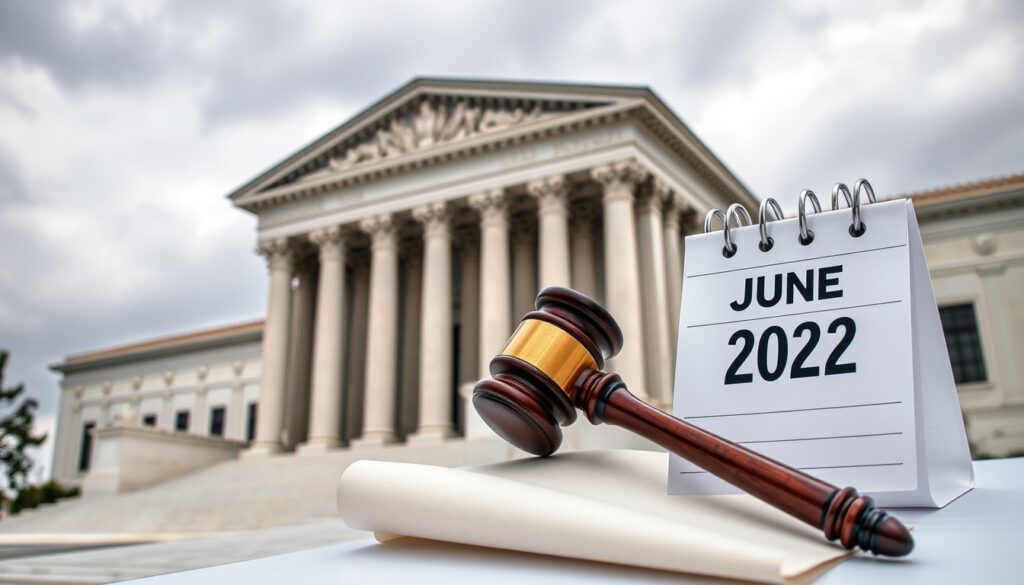
When Was Roe v. Wade Overturned? Date and Vote
When the Supreme Court overturned Roe v. Wade, it wasn’t just a legal ruling — it was the culmination of a 50-year campaign to reshape American abortion law. On June 24, 2022, the Court issued its decision in Dobbs v. Jackson Women’s Health Organization, dismantling a constitutional right that had stood for nearly half a century.
Date overturned: June 24, 2022 ·
Case name: Dobbs v. Jackson Women’s Health Organization ·
Supreme Court vote: 5-4 ·
Years Roe v. Wade was in effect: 49 years (1973–2022)
Quick snapshot
- Roe was overturned on June 24, 2022, in Dobbs v. Jackson Women’s Health Organization (Supreme Court of the United States)
- The vote to overrule Roe was 5-4 (Harvard Kennedy School)
- The majority opinion was authored by Justice Samuel Alito (Supreme Court syllabus)
- The decision returned abortion regulation to the states (Network for Public Health Law)
- January 22, 1973: Roe v. Wade established constitutional right to abortion (Oyez)
- June 24, 2022: Dobbs decision overruled Roe (Supreme Court of the United States)
- State legislatures are enacting or defending abortion bans and protections (Network for Public Health Law)
- Litigation over medication abortion (mifepristone) continues at the Supreme Court (Network for Public Health Law)
Here are the key facts about the Dobbs decision in a nutshell.
| Label | Value |
|---|---|
| Date | June 24, 2022 |
| Case | Dobbs v. Jackson Women’s Health Organization |
| Vote | 5-4 (to overrule Roe); 6-3 on judgment |
| Majority opinion by | Justice Samuel Alito |
| Effect | Abortion rights returned to states |
When Was Roe v. Wade Overturned?
The Supreme Court announced its decision in Dobbs v. Jackson Women’s Health Organization on June 24, 2022 (Supreme Court of the United States). The ruling overturned both Roe v. Wade (1973) and Planned Parenthood v. Casey (1992), eliminating the federal constitutional protection for abortion.
How Long Was Roe v. Wade in Effect?
Roe v. Wade was the law of the land for exactly 49 years — from January 22, 1973, until June 24, 2022 (Oyez). During that period, the Court reaffirmed its core holding in Casey (1992), but allowed states to impose some restrictions.
Is Roe v. Wade Still Overturned?
Yes. As of June 2022, Roe v. Wade remains overturned. The Dobbs decision has not been reversed by any subsequent ruling. The case citation is Dobbs v. Jackson Women’s Health Organization, 597 U.S. 215 (2022) (Cornell Law School Wex).
The 5-4 vote to overturn Roe was the narrowest possible majority, meaning a single justice switch would have preserved the precedent.
Why Did the US Supreme Court Overturn Roe v. Wade?
The Court’s majority, led by Justice Samuel Alito, held that The Constitution does not confer a right to abortion
(Supreme Court opinion). The decision argued that Roe was egregiously wrong
from the start and that the authority to regulate abortion should be returned to the people’s elected representatives (National Constitution Center). The conservative legal movement had spent decades building a case to overturn Roe, beginning with inroads in state legislatures and culminating in the appointment of three justices by President Donald Trump (Harvard Magazine).
The ruling also overturned Planned Parenthood v. Casey, which had previously reaffirmed Roe. The Court declared that the undue burden
standard from Casey was no longer valid (Cornell Law School Wex).
The Constitution does not confer a right to abortion. Roe and Casey are overruled.
— Justice Samuel Alito, majority opinion in Dobbs v. Jackson Women’s Health Organization (2022)
The implication: the debate over abortion now shifts to 50 state legislatures, with some moving quickly to ban or protect access.
Who Voted to Overturn Roe v. Wade and Who Voted to Uphold It?
Who gave the majority opinion in Roe v. Wade?
The original Roe v. Wade opinion was written by Justice Harry Blackmun in 1973 (Oyez). In Dobbs, Justice Samuel Alito authored the opinion for the majority.
How did each justice vote?
The vote to overrule Roe was 5-4. Justices Thomas, Alito, Gorsuch, Kavanaugh, and Barrett voted to overrule. Chief Justice John Roberts concurred in the judgment (upholding Mississippi’s 15-week ban) but did not join the part of the opinion that overruled Roe. Justices Breyer, Sotomayor, and Kagan dissented (Supreme Court syllabus).
The court has betrayed its trust.
— Justice Stephen Breyer, dissenting opinion in Dobbs (2022)
The pattern: every justice appointed by a Republican president voted to overrule Roe, while those appointed by Democratic presidents dissented.
What Happened After Roe v. Wade Was Overturned?
Within hours of the decision, abortion bans triggered in several states — including Arkansas, Kentucky, Louisiana, Missouri, and South Dakota (Network for Public Health Law). Other states had laws waiting for a trigger event.
Have abortions increased since Roe was overturned?
Data is still emerging and varies by state. One study found that in the year after Dobbs, the number of abortions decreased in states with bans but increased moderately in states where abortion remained legal (PubMed). The overall national count remained relatively stable as people traveled to other states.
What are the effects of Roe v. Wade being overturned?
The decision created a patchwork of state laws. As of early 2025, 14 states had near-total abortion bans, while others protected access (Center for Reproductive Rights). The Guttmacher Institute reported a significant increase in interstate travel for abortion services.
The Supreme Court is now considering a case that could restrict access to mifepristone, the most common medication abortion drug. That decision could further reshape the post-Dobbs landscape.
The aftermath shows that the legal battle has shifted from federal to state arenas, with unpredictable consequences.
Why Did Ruth Bader Ginsburg Not Like Roe v. Wade?
Justice Ruth Bader Ginsburg was a long-time critic of Roe’s legal reasoning. She argued that the decision went too far, too fast, and was vulnerable to political backlash (Harvard Magazine). She preferred a more incremental approach that framed abortion rights in terms of gender equality under the Equal Protection Clause.
Roe v. Wade…is not about women’s autonomy; it’s about doctors’ rights.
— Justice Ruth Bader Ginsburg, speaking in 2009
Why is it called Roe v. Wade?
The case is named after “Jane Roe,” the pseudonym for Norma McCorvey, the plaintiff, and Henry Wade, the Dallas County district attorney who enforced the Texas abortion ban (Oyez).
The catch: Ginsburg’s critique proved prescient — the broad ruling created a political target that the conservative legal movement spent 50 years dismantling.
Timeline: The Road to Overturning Roe v. Wade
- — Roe v. Wade decision establishes constitutional right to abortion (Oyez).
- — Planned Parenthood v. Casey reaffirms core holding of Roe (Cornell Law School Wex).
- — Supreme Court agrees to hear Dobbs v. Jackson Women’s Health Organization (Oyez).
- — Oral arguments in Dobbs case (Supreme Court of the United States).
- — Politico publishes leaked draft majority opinion (Harvard Magazine).
- — Supreme Court issues Dobbs decision, overturning Roe v. Wade (Ballotpedia).
This timeline illustrates the long arc of the legal campaign.
What’s Confirmed and What’s Still Unclear
Confirmed facts
- Roe was overturned on June 24, 2022 (Supreme Court of the United States).
- The vote was 5-4 to overrule (Harvard Kennedy School).
- The case is Dobbs v. Jackson Women’s Health Organization (Oyez).
- The majority opinion was written by Justice Samuel Alito (National Constitution Center).
What’s unclear
- The exact long-term impact on abortion numbers nationwide is still being studied (PubMed Central).
- Future federal legislation on abortion rights remains uncertain.
While the core facts are clear, the full consequences will take years to measure.
Summary
The overturning of Roe v. Wade on June 24, 2022, ended a 49-year-old constitutional right and returned the abortion debate to the states. For women in states with abortion bans, the decision means limited access to care, while for the legal movement that spent decades working to overturn Roe, the challenge now shifts to defending those restrictions in court.
Related reading: USA News Today Headlines: Top Breaking Stories & Latest Updates
en.wikipedia.org, law.cornell.edu, ballotpedia.org, hpmmatters.publichealth.gwu.edu
För en djupare förståelse av hur domstolen nådde detta beslut, se Roe v. Wade-upphävandets bakgrund.
Frequently Asked Questions
What was the Roe v. Wade case summary?
Roe v. Wade was a 1973 Supreme Court case that established a constitutional right to abortion under the Due Process Clause of the Fourteenth Amendment (Oyez).
What is the Dobbs decision?
The Dobbs decision is the 2022 Supreme Court ruling in Dobbs v. Jackson Women’s Health Organization that overturned Roe v. Wade and Planned Parenthood v. Casey (National Constitution Center).
How many states have banned abortion since Dobbs?
As of early 2025, 14 states have near-total abortion bans (Center for Reproductive Rights).
Can the Supreme Court overturn Roe again?
Roe v. Wade has already been overturned by the Dobbs decision. The current Court could potentially restore a constitutional right to abortion through a future case, but that would require a new ruling.
What is the difference between Roe and Casey?
Roe established a trimester framework, while Casey replaced it with an “undue burden” standard. Dobbs overruled both (Cornell Law School Wex).
Who wrote the majority opinion in Dobbs?
Justice Samuel Alito wrote the majority opinion (Supreme Court of the United States).
When did the Dobbs decision come down?
The decision was issued on June 24, 2022 (Ballotpedia).
These answers provide a quick reference to the most common questions about the Dobbs ruling.
More related posts
 Movie Showtimes Near Me: What’s Playing in Irish Cinemas Today
 Wait Wait… Don’t Tell Me! – Hosts, Streaming, and Show History
 In the Heights Movie Cast: Actors, Roles & Broadway Origins
 Older Drivers License Changes US 2025 – What Seniors Need to Know
 Have You Ever Seen the Rain: Original, Covers, Meaning & Tragedy
 Suki Fast and Furious – Complete Character Guide
 Six Feet Under Cast: Main Actors Then and Now (2025)
 Park Bo-gum: Military, Ireland, English & V Friendship
