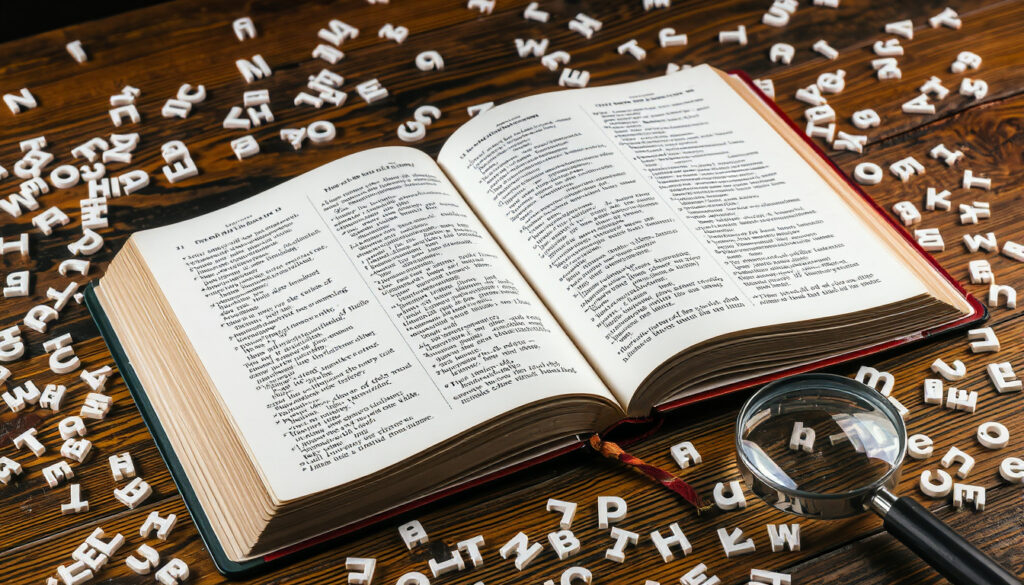
How Many Words Are in the English Language? Facts & Figures
Anyone who has tried to count stars or grains of sand knows the feeling: the more you look, the more you find. The English language is no different.
Estimated total English words: ≈1 million (including technical terms) ·
Oxford English Dictionary (2nd ed.): ~600,000 word forms ·
Average native speaker vocabulary: 15,000–20,000 lemmas ·
Word with most meanings: set (645 definitions) ·
Longest English word (chemical name): 189,819 letters (titin) ·
Language with most words (variable): English often cited, but depends on counting method
Quick snapshot
- No single definitive count of all English words exists (MyVocab.info)
- ‘Set’ holds the record for most meanings (645) in Guinness World Records (Wikipedia)
- The chemical name for titin is the longest word (189,819 letters) (MyVocab.info)
- Exact number of words in English (estimates vary from 600,000 to 1 million+) (Wikipedia (OED))
- Whether English truly has more words than all other languages (dependent on counting methodology) (PubMed Central)
- How many words a typical person knows (estimates range from 15,000 to 30,000 lemmas) (Preply)
- 1928: First edition of the Oxford English Dictionary published with ~400,000 entries (Wikipedia)
- 1989: Second edition published with ~600,000 word forms (Wikipedia (OED))
- English has at least 26,000 word families (Nation-Bauer approach) (MyVocab.info)
- Better corpus tools will refine per-speaker vocabulary estimates (MyVocab.info)
- Cross-language comparisons using headword counts may become more standard (PubMed Central)
Six key facts show the range and the ambiguity at a glance:
| Label | Value |
|---|---|
| OED word forms (2nd edition) | ~600,000 |
| Merriam-Webster estimate | ~1 million words (including technical) |
| Average native vocabulary (lemmas) | 15,000–20,000 |
| Word with most definitions | set (645) |
| Longest English word | 189,819 letters (titin chemical name) |
| Language with most words (often cited) | English |
The pattern: no single number can be authoritative because every counting method—dictionary headwords, word families, corpus tokens—produces a different result.
How many words are in the English language in total?
Does English have 1 million words?
The short answer is: it can, if you count generously. Merriam-Webster estimated that English vocabulary includes roughly 1 million words when technical terms, slang, and regional variants are added. But the Oxford English Dictionary (2nd edition) lists about 600,000 word forms. The difference is a matter of what you define as a “word.” Preply, a language learning platform, notes that vocabulary test results above 10,000 are rounded to the nearest 100, and that the margin of error is about ±10%. So even the tools we use to estimate carry uncertainty.
Are there 500,000 words in English?
Yes, if you stick to established dictionary entries. The OED’s 600,000 includes many obsolete and rare forms, but a core count around 500,000 is common. For comparison, the Collins English Dictionary (14th edition) boasts more than 732,000 words, meanings, and phrases, according to Wikipedia (dictionary comparison). The catch: Collins counts “meanings and phrases” alongside headwords, inflating the total.
How many words does the average person know?
The median native English speaker knows around 15,000 word families. The 25th percentile is about 12,500, the 75th is 17,200, and the 90th reaches 19,600. For language learners, the median drops to 5,900 word families, with a 90th percentile of 10,400. These numbers are based on the Nation-Bauer word-family approach, which groups inflected forms under a single lemma.
How many words in English are commonly used?
Everyday conversation relies on roughly 3,000 to 5,000 word families. A study on bilingual children found that efficiency in online processing was significantly related to vocabulary size in the same language, after controlling for processing speed and vocabulary size in the other language. This indicates that even in daily use, vocabulary size matters for comprehension speed.
For anyone trying to “learn all the words,” the goal is impossible. English has hundreds of thousands of words, but knowing 15,000 word families already puts you in the top half of native speakers. Focus on the most common 5,000 and you can understand 90% of everyday texts.
The implication: Learners should target high-frequency vocabulary first, as it delivers the most practical coverage. The rest of the dictionary remains a reference tool, not a checklist.
Which language is richest in words?
How many words are in the English language compared to other languages?
The question is method-dependent. English often claims the largest vocabulary because of its history of borrowing from Latin, French, and Germanic roots, plus its modern role as the language of science and technology. However, a study comparing Spanish and English bilingual children found that Spanish and English vocabularies were similar in size overall in the tested group. The key finding: Spanish vocabulary size was not predictive of English vocabulary size for individual children, suggesting that exposure and processing speed matter more than the raw size of the lexicon.
The following table compares dictionary-based counts across languages:
| Language | Dictionary headwords | Alternative counts |
|---|---|---|
| English | 600,000–1,000,000 (OED / Merriam-Webster) | 1,453,952 entries in English Wiktionary |
| Spanish | ~200,000 (Real Academia) | Higher if inflected forms are counted separately |
| Arabic | ~200,000 (modern dictionary) | Up to 12 million if root-based derivatives are included |
How many words are in the Spanish language?
The Diccionario de la Real Academia Española includes about 200,000 entries. If you count all inflected forms, the number grows, but Spanish doesn’t allow the same level of free compounding that English does.
How many words are in the Arabic language?
Arabic is often said to have 12 million words if you count every possible root-based derivative. But that number conflates every potential form with actually used words.
How many words are there in the world?
No global census of words exists. The Wikipedia list of dictionaries by number of words shows that the English Wiktionary has 1,453,952 total entries, but that includes translations, phrases, and archaic terms.
Counting dictionary headwords gives English a huge lead. Counting what a typical speaker actually knows levels the playing field: a native Arabic speaker may command as many words as an English speaker, but the dictionary of Arabic looks smaller because it is organized around roots, not surface forms.
Which word has 645 meanings?
What is a 190,000-letter word?
The longest English word is the chemical name for the protein titin, comprising 189,819 letters. It is rarely used except as a novelty. The Guinness World Records recognizes “set” as the word with the most definitions in English: its entry in the OED runs 60,000 words across 645 meanings.
How do you say 6 times in one word?
The English word “sextuple” means sixfold. There are also “sestet” for a group of six, and “sexagenary” relating to the number 60. These are rare but valid.
The existence of a 645-meaning word like “set” shows that counting words by meaning is even harder than counting by form. A single word can carry dozens of distinct definitions, and any dictionary entry is a human editorial decision about where to draw lines.
The takeaway: word counts are inherently fuzzy because every unit—form, lemma, meaning—requires editorial judgment.
What is the #1 hardest language?
What is the easiest language to speak?
For native English speakers, the Foreign Service Institute ranks Category I languages (e.g., Norwegian, Swedish, Dutch) as the easiest, requiring about 600 classroom hours. Category V includes Mandarin, Arabic, Japanese, and Korean, which can take 2,200 hours. FSI’s rankings are based on linguistic distance from English, not on an intrinsic difficulty scale. The methodological problem in cross-language comparisons is that languages differ in how they express meaning through inflection, compounding, and derivation.
Which language is hardest for English speakers? Mandarin Chinese often tops the list because of its tonal system and writing system. Arabic challenges with its root-based morphology and script. Japanese has three writing systems and complex politeness levels. The hardest language does not have more words; it just has a greater learning curve for an English speaker.
Who can speak 42 languages fluently?
Powell Janulus holds a Guinness World Record for fluency in 42 languages. His ability is exceptionally rare: hyperpolyglots—people who speak 10+ languages—are a tiny fraction of the world. The definition of “fluent” varies; some polyglots can hold conversations in many languages but may not have equal literacy in all. Systematic methods and early exposure are common among them. Claims of fluency are debated because standardized testing is rare for these individuals.
The implication: for the average person, learning one new language to a functional level is a major achievement. The Guinness record underscores that extreme multilingualism is a curiosity, not a benchmark.
Frequently asked questions
What does the 1 million count include?
Merriam-Webster includes technical terms, slang, and regional variants. The OED (2nd ed.) lists ~600,000 word forms.
What is the core OED vocabulary size?
The OED’s 600,000 includes many obsolete and rare forms; a core count around 500,000 is common.
What vocabulary sizes do native speakers have at percentiles?
Median: ~15,000 word families; 25th percentile: 12,500; 75th: 17,200; 90th: 19,600.
How does Spanish word count compare to English?
The Real Academia Española dictionary has ~200,000 headwords; inflected forms increase that but are counted differently.
Which languages are easiest for English speakers?
FSI ranks Norwegian, Swedish, Dutch as easiest (~600 hours). Arabic, Mandarin, Japanese are hardest (~2,200 hours).
For anyone curious about English size, the answer is not a number but a range: 600,000 to 1 million words exist, but a speaker only needs 15,000 word families to be well above average. The choice for language learners is clear: focus on the most common 5,000 words first, and let the dictionary do the rest.
More related posts
 Lexus LFA for Sale: Current Prices, Listings & Rare Finds
 Furniture Stores Near Me: Dublin & Ireland 2025 Guide
 Average Height for Men: US, World, and Percentiles
 Park Bo-gum: Military, Ireland, English & V Friendship
 Napa Valley Wine Train – 2025 Tickets Schedule Reviews Guide
 How to Watch Thursday Night Football – 2024 Streams Channels Free Options
 Samsung Galaxy S25 Ultra Reviews – Specs, Battery and Camera Tests
 Pittsburgh Pirates Fan Falls: What Happened to Kavan Markwood
