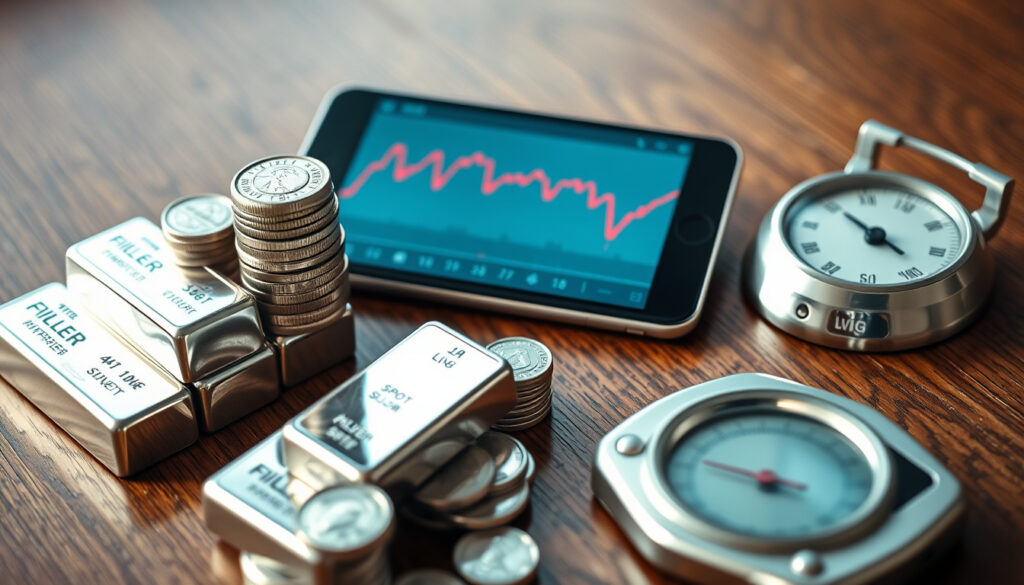
What’s the Price of Silver Today? Spot & Selling Tips
The price of silver today is not a single number — it’s a moving range that depends on the feed, the timestamp, and whether you’re buying or selling. This guide anchors that price to live dealer feeds, works out the melt value of the coins and flatware most people own, and maps how to sell without leaving money on the table.
Spot price range: $64.46–$67.12 per troy ounce (dealer feeds, Sep 23, 2026) ·
Day change: Down about $2.24–$2.46 on sampled feeds ·
Per gram: $2.09–$2.16 ·
Per kilo: $2,085.62–$2,157.89 ·
$10 roll of silver quarters: Roughly $466–$486 at those spot levels
Quick snapshot
- Ounce, gram, and kilo spot quotes from live dealer feeds (Kitco (dealer-run price feed))
- Quotes carry timestamps and bid/ask spreads — check both (NGC (coin-grading authority))
- Spot applies to .999 fine silver, not to all silver products (JM Bullion (melt-value guide))
- Calculate melt value before you get a quote (GoldSilver (precious metals retailer))
- Know whether your coins carry a premium over melt (USAGold (coin and bullion dealer))
- Compare pawn shop vs bullion dealer quotes before committing (GoldSilver (selling guide))
- 1964 quarter: 0.1808 troy oz of silver per coin (MetalCharts (silver melt calculator))
- Morgan dollar: 0.7734 troy oz of silver per coin (Cash 4 Gold Trading Post (coin buyer’s price guide))
- Sterling flatware: only 92.5% silver by weight (JM Bullion (melt-value guide))
- Current dealer quotes sit far below the $100/oz target some forecasts float (Trading Economics (commodity price aggregator))
- Bank holdings: public data cannot name the single largest holder (Trading Economics (commodity price aggregator))
- Tax rules apply when you sell — confirm current IRS guidance before a big sale (Trading Economics (commodity price aggregator))
Key facts at a glance
Seven numbers, one pattern: the quote changes by the minute and varies by source, so it’s the range that matters, not a single tick.
| Metric | Value as of Sep 23, 2026 |
|---|---|
| Live silver spot range | $64.46–$67.12 per troy ounce (dealer feeds) — Trading Economics (market data), JM Bullion (dealer chart) |
| Silver per gram | $2.09–$2.16 — JM Bullion (dealer chart) |
| Silver per kilogram | $2,085.62–$2,157.89 — Kitco (dealer feed) |
| Day change | -$2.24 to -$2.46 on sampled feeds — Kitco (dealer feed) |
| Pre-1965 silver quarter | 0.1808 troy oz of silver per coin — MetalCharts (melt calculator) |
| Morgan dollar | 0.7734 troy oz of silver per coin — Cash 4 Gold Trading Post (coin guide) |
| Sterling silver | 92.5% silver by weight — JM Bullion (melt-value guide) |
The pattern here is the spread: the cheapest quote and the most expensive quote differ by more than two dollars per ounce, which is exactly why “what’s the price of silver today” needs a follow-up question — which feed, and at what minute?
How much is 1 oz of silver right now?
Short answer: right now, one troy ounce of .999 fine silver is quoted at roughly $64 to $67, depending on the dealer feed and the timestamp on the quote. Trading Economics (commodity price aggregator) showed about $64.41, JM Bullion (precious metals dealer) quoted $65.52 at 10:54 AM EDT, Kitco (dealer-run price feed) printed $66.92 on the evening of September 22, and Bullion.com (dealer spot feed) reached $67.84 late that same afternoon.
NGC (coin-grading authority) posted a bid of $67.00 and an ask of $67.15 at 3:15:16 p.m. EDT on September 22 — a 15-cent spread inside a single feed. The wider gap between pages is timing: the silver market moves every minute, and each dealer stamps a different moment onto its quote.
Why do dealer prices show different numbers?
- Timestamps differ: JM Bullion’s $65.52 was stamped 10:54 AM EDT on Sep 23; Kitco’s $66.92 was stamped 5:52 p.m. ET on Sep 22 (JM Bullion (dealer chart), Kitco (dealer feed))
- Bid vs ask differs: a buy quote sits below a sell quote, and some pages show one or the other (NGC (spot table))
- Feed types differ: mid-prices, last trades, and bid/ask tables are not the same number (Bullion.com (dealer spot feed))
None of these numbers is wrong. They are snapshots of a market that has already moved on. The useful habit is to read the timestamp and the bid/ask label before you treat any quote as “the price.”
What is the difference between spot price and the price I pay for bullion?
- Spot price applies to .999 fine silver — the pure industrial-grade metal (JM Bullion (melt-value guide))
- Bullion products add a premium over spot for minting, distribution, and dealer margin (USAGold (coin and bullion dealer))
- A one-ounce American Silver Eagle typically sells $5 to $10 above melt value, depending on market conditions (USAGold (coin and bullion dealer))
So the spot price is the base layer. What you actually pay for a coin or bar includes the premium; what a dealer pays you for scrap or common coins usually subtracts a spread from that same base layer.
How much is a gram of silver worth today?
- One troy ounce equals 31.1035 grams (JM Bullion (melt-value guide))
- Gram value = ounce spot ÷ 31.1035, which puts today’s range near $2.09–$2.16 per gram
- One kilogram = 32.1507 troy ounces, putting the kilo range near $2,085.62–$2,157.89
The gram and kilo rows on dealer pages are just the ounce price divided or multiplied; they add no new information, but they matter when you weigh scrap or flatware at home in grams.
The implication: if two dealer pages disagree by a couple of dollars at the same moment, neither is broken. Check the clock and the bid/ask label, and the disagreement stops being confusing.
Will silver hit $100 per ounce?
If you are asking because a headline or a video promised $100 silver, the market’s answer today is a quiet no. No major silver exchange has ever recorded a $100 spot print. Trading Economics (commodity price aggregator) had silver near $64.41 on September 23, 2026, and JM Bullion (precious metals dealer) quoted $65.52 — roughly a third below the round-number target.
The historical record makes $100 look even farther away. Kitco’s (dealer-run price feed) historical chart shows silver near $50/oz in 1980 and near $49/oz in April 2011. The current range sits above both old records — and still has a long climb to $100.
What would move silver to $100?
- Industrial fabrication, investment products, mine output, inflation expectations, and interest rates are the core supply-demand drivers (Trading Economics (commodity overview))
- A doubling of the price would require a demand shock large enough to outrun mine supply, which takes years to expand
- Investment flows into silver ETFs and physical products can add a premium layer quickly, but they can also reverse quickly
For silver to go from the current $64–$67 range to $100, you would need a simultaneous industrial boom and a rush of investment buying — plus a supply side that cannot respond. That is a scenario, not a trading signal.
Has silver ever traded at $100?
- 1980: silver spiked near $50/oz after heavy accumulation by the Hunt brothers, then reversed sharply on a market rule change and margin calls (Kitco (historical chart))
- April 2011: silver touched about $49/oz, the highest print in three decades (Kitco (historical chart))
- 2026: dealer feeds sample $64–$67 — above the old records, still far from $100 (Trading Economics (market data))
The precedent is cautionary: both record runs ended in violent corrections. The market has had two chances to hold above $50, and both times it failed.
What is the difference between forecast and guarantee?
- A market quote is a live, executable number — someone will trade on it right now
- A forecast is a modeled opinion about a future range, not a price anyone has to honor
- Published silver forecasts vary widely, and a $100 target should be read as a scenario, not as today’s market price
Round-number targets are great at getting attention and terrible at pricing a sale. The only number that settles a transaction is the dealer’s live quote on the day you call.
A $100 silver price would require roughly a 50% jump from the top of the current $64–$67 range. Watch industrial demand and ETF flows before betting on a round-number headline.
Which bank holds the most silver?
Straight answer: public data does not know. Private bullion banks do not disclose their own silver positions or their customers’ positions in a way that allows outsiders to rank them. The London Bullion Market Association publishes vault holdings in aggregate, not by named bank, so “which bank holds the most silver” is one of those questions that sounds answerable but is not — at least from public sources.
What can be said: silver is not a major official reserve asset for most central banks, whose public reserve reporting skews overwhelmingly to gold. And the spot price is made on exchanges and dealer networks — the numbers on Kitco’s (dealer-run price feed) — not announced from a bank vault.
How much silver do central banks report holding?
- Central bank reserve disclosures emphasize gold; silver holdings are small by comparison for most countries
- No central bank publishes a daily silver price — the market does, through dealer feeds like Kitco (dealer feed)
- Official reserve data therefore tells you almost nothing about who holds the most silver
What is the difference between a bullion bank and a central bank?
- Bullion banks trade, finance, and clear metal for commercial clients
- Central banks manage national reserves and monetary policy
- “Which bank holds the most silver” usually means bullion banks — and they do not publish audited silver inventory
Where is commercial silver stored?
- LBMA-affiliated vaults hold commercial metal in London and other trading hubs
- Reported vault data is aggregated, so an individual bank’s stack cannot be isolated
- The practical takeaway: if no one can prove which bank holds the most, treat any confident claim as marketing
This section is deliberately short. The research pack found no public register that ranks private silver holders, and a confident answer would require an audit the market does not publish.
How much can I sell 1 oz of silver for?
Less than spot — usually several dollars less. The dealer’s buy price is the number that pays you, and it sits below the headline quote because the dealer’s margin covers overhead, transport, and profit. JM Bullion (precious metals dealer) and GoldSilver (precious metals retailer) both define melt value the same way: fine-silver weight in troy ounces multiplied by the current spot price.
The distance between that melt calculation and the cash on the counter is the buy spread. It is the true cost of selling, and it varies by buyer type more than by the spot price itself.
What is the spread between spot and dealer buy price?
- The wholesale market itself has a bid/ask gap: NGC’s spot table quoted bid $67.00 / ask $67.15 on September 22 (NGC (coin-grading authority))
- Retail dealer spreads are wider: dealers buy below the market bid and sell above the market ask
- The wider the spread, the more of the spot price you give up when selling quickly
A 15-cent wholesale spread is already visible inside one feed on one afternoon. A retail buy quote can sit several dollars below spot once the dealer’s margin is applied.
Are silver coins worth more than silver bars when selling?
- Government bullion coins like the American Silver Eagle carry a premium over melt; USAGold (coin and bullion dealer) gauges it at $5–$10 for a one-ounce Eagle in normal conditions
- Generic .999 bars trade closer to spot — less premium to lose, but no collector cushion either
- “Junk” 90% silver coins are priced almost entirely by melt: about 0.715 troy oz per $1 of face value across dimes, quarters, and halves (Cash 4 Gold Trading Post (coin buyer’s guide))
The premium question decides your selling strategy. If an item trades above melt, sell it as a coin; if it is generic bullion, the melt price is the whole game.
How do I calculate the melt value of one ounce of silver?
- Formula: fine-silver weight in troy ounces × current spot = melt value (JM Bullion (melt-value guide), GoldSilver (selling guide))
- One troy ounce of .999 fine silver → melt = spot ($66.25 of silver at $66.25 spot)
- One troy ounce of sterling → melt = 0.925 × spot (about $61.28 at $66.25 spot)
The arithmetic is identical for coins, bars, and flatware. The only variables are the weight, the purity, and the moment of the spot quote.
How to sell silver without getting ripped off?
Most “rip-offs” in silver selling are not fraud — they are spread. You accept the first quote without knowing the melt floor, and the buyer keeps the difference. The fix is arithmetic: confirm the metal, weigh it, compute melt, then get competing quotes. GoldSilver’s (precious metals retailer) selling guide follows the same sequence for coins, and the logic applies to flatware and scrap unchanged.
Is it better to sell silver as is or melt it?
- Melting destroys collector value: a coin with a premium, like an American Silver Eagle at $5–$10 above melt, becomes generic metal once melted (USAGold (coin and bullion dealer))
- Coins and intact flatware sets sell for more as themselves when condition or pattern adds value
- Only true scrap — broken pieces, bent or damaged bars — makes sense to sell for melt value
Melt is the floor, not the ceiling. The moment you melt a coin, you permanently delete any premium above that floor.
Do you pay taxes on silver if you sell it?
- U.S. federal tax law treats silver as a collectible for capital gains purposes (IRS guidance)
- The tax depends on your holding period, the size of the gain, and your income situation
- Rules change — confirm the current IRS treatment before completing a large sale
Tax does not change the melt math, but it changes the net proceeds. A profitable sale can create a tax bill, so factor it into the decision to sell now versus later.
What documents should I get when selling silver?
- A written quote with weight, purity, and payout — before you hand over the metal (GoldSilver (selling guide))
- A dated receipt after the sale, plus clarity on how payment will be made and when it clears
- Two or three competing quotes beat one: compare each against the current spot price (GoldSilver (selling guide))
Same silver, same day, two different buyers can produce two very different cash offers. The loser is usually the seller who quotes from memory instead of from a written comparison.
How much is a $10.00 roll of silver quarters worth today?
A $10 roll holds 40 Washington quarters. If all 40 are pre-1965, they are 90% silver and each carries 0.1808 troy oz of silver (MetalCharts (melt calculator)). That is 7.232 troy oz per roll. At the sampled spot range of $64.46–$67.12, the roll’s melt value works out to roughly $466–$486 — before any premium a coin dealer might add for date or condition.
How much is a 1964 silver quarter melt value today?
- 1964 quarter silver content: 0.1808 troy oz (MetalCharts (melt calculator))
- Melt = 0.1808 × current spot → at $66.25, MetalCharts computes $11.98
- Scale up: a $10 roll (40 quarters) ≈ 7.2 troy oz → roughly $466–$486 at the sampled range
USAGold’s guide offers a parallel check: at $70 spot, a pre-1965 quarter contains about $12.66 in silver (USAGold (value guide)). Two calculators, same math, slightly different spot assumptions.
How much is a $1 Morgan silver dollar worth?
- Morgan and Peace dollars contain 0.7734 troy oz of silver (Cash 4 Gold Trading Post (coin guide))
- Melt = 0.7734 × spot → about $51 at $66.25
- Morgan dollars also carry numismatic value, which is distinct from melt value (JM Bullion (melt-value guide))
A common-date circulated Morgan is worth melt plus a modest premium; a key date can be worth many times melt. The 0.7734 oz number is your floor, not your ceiling.
How do I tell if a quarter is silver?
- Date check: 1964 and earlier are 90% silver; 1965 and later are clad and generally have no silver melt value (U.S. Coin Book (coin melt values))
- Edge check: silver quarters show a solid silver band; clad quarters show a copper stripe
- Weight check: silver quarters are slightly heavier than clad — when in doubt, weigh them
The 1964/1965 line is the one that matters for quarters. Sorting by date first will identify 99% of the silver in a typical coin jar.
At $66.25, one 1964 quarter is $11.98 in silver — a fact from MetalCharts’ calculator, not a coin-shop estimate. Knowing that number turns a counter conversation into a negotiation instead of a price-take.
The pattern: old coins in a roll are worth many times face value, but the melt floor — not the face value — is the number that protects you at the counter.
How much is a 12 piece set of sterling silver flatware worth?
Sterling silver is 92.5% silver and 7.5% alloy (JM Bullion (melt-value guide)). A 12-piece set’s value starts with total weight, then multiplies by 0.925 and the current spot, then adjusts for pattern, maker, and condition. The formula is identical to coins: fine-silver weight × spot = melt value (GoldSilver (selling guide)).
How much will a pawn shop pay for 925 silver?
- Pawn shops and general secondhand buyers quote a discounted percentage of melt to protect their resale margin
- That discount varies from shop to shop — the only way to find the range is to get two or three quotes (GoldSilver (selling guide))
- A bullion dealer or refiner will usually quote closer to melt than a pawn shop will
The pawn shop is selling convenience, not silver. If you are already willing to call around, the payout improves.
How do I weigh sterling flatware for melt value?
- Weigh every piece in grams, then convert: grams ÷ 31.1035 = troy ounces (JM Bullion (melt-value guide))
- Melt = troy ounces × 0.925 × current spot
- Worked unit-rate: 100 grams of sterling = 3.215 troy oz → 2.974 troy oz of pure silver; at $66.25 that is about $197 per 100 grams
A kitchen scale in grams is enough. The formula does the rest, and the result is your walk-away number.
What is the difference between sterling silver and silver plate?
- Sterling is 92.5% silver throughout the metal (JM Bullion (melt-value guide))
- Silver plate is a thin layer of silver over a base metal and carries little melt value
- Check the marks: “925” or “STERLING” mean solid silver; plated pieces usually say “plate”
Flatware is where sellers overestimate value most. The “silver” in silver plate is measured in microns, not ounces — let the marks and the scale decide, not the shine.
Selling channels compared: who pays closest to spot
Four selling routes, one pattern: the more specialized the buyer, the closer the payout tracks melt value.
| What you sell | How the quote is built | Typical behavior vs spot |
|---|---|---|
| Generic .999 silver bar | Weight × spot; no collector premium (JM Bullion (melt-value guide)) | Close to spot, minus the dealer’s spread |
| American Silver Eagle / government bullion coin | Melt plus sovereign and collector premium (USAGold (coin and bullion dealer)) | Premium on both sides; $5–$10 over melt on typical purchases |
| 90% silver “junk” coins (pre-1965) | Melt based on content — about 0.715 oz per $1 of face value (Cash 4 Gold Trading Post (coin guide)) | Priced on melt; the dealer keeps a buy spread |
| Sterling flatware and scrap (925) | Weight × 0.925 × spot (GoldSilver (selling guide)) | Bullion dealers and refiners quote nearest melt; pawn shops discount |
The pattern: if the buyer does not handle precious metal daily, the spread widens. A bullion dealer’s quote is the closest a home seller gets to the headline number.
Selling for melt value: the trade-offs
One decision, two directions: sell the object as-is, or reduce it to melt. The math is the same; the premium is the difference.
Upsides
- Melt value is transparent: one formula, no guesswork (GoldSilver (selling guide))
- You can research the premium before selling, so you never give it away unknowingly (USAGold (value guide))
- Melt is marketable anywhere: dealers, refiners, and online buyers all quote it
Downsides
- Melting a coin or intact flatware set permanently destroys its numismatic or pattern value (JM Bullion (melt-value guide))
- Melt payouts from pawn shops run below spot, sometimes well below (GoldSilver (selling guide))
- You still owe tax on the gain if the sale is profitable (IRS guidance)
The upshot: sell the object before you melt the metal. The melt tank is the last resort, not the first stop.
Selling silver: a six-step checklist
Six steps, one goal: know your floor before you negotiate.
- Identify the metal — “925” or “STERLING” marks mean 92.5% silver; pre-1965 U.S. coins are 90%; plated items say “plate” (Cash 4 Gold Trading Post (coin guide))
- Weigh everything — grams are fine; convert to troy ounces by dividing by 31.1035 (JM Bullion (melt-value guide))
- Compute melt — troy ounces × purity × current spot (GoldSilver (selling guide))
- Check the live spot on a timestamped dealer feed (Kitco (dealer feed), JM Bullion (dealer chart))
- Get two or three written quotes — bullion dealer, coin shop, refiner — and compare each against melt (GoldSilver (selling guide))
- Take the best quote and get a receipt with weight, purity, payout, and date (GoldSilver (selling guide))
Why this matters: every skipped step costs dollars, not cents. The seller who weighs first and quotes second almost always beats the one who walks in cold.
Silver price history: three reference points
Three moments, one pattern: every run to a record has reversed hard — and the current range is already above the old records.
| Year | What happened | What it signals |
|---|---|---|
| 1980 | Silver neared $50/oz after sustained accumulation by the Hunt brothers; a market rule change and margin calls produced a sharp reversal (Kitco (historical chart)) | Leveraged rallies can unwind fast |
| April 2011 | Silver traded near $49/oz, the highest print since 1980 (Kitco (historical chart)) | It took 31 years to approach the old record |
| September 23, 2026 | Sampled dealer feeds quoted silver at roughly $64.46–$67.12 per troy ounce (Trading Economics (market data), JM Bullion (dealer chart)) | The market is above the old records and still about a third below $100 |
Why this matters: $100 is farther away in percentage terms than it looks in headlines. The historical path ran through $50 twice — and both times it stopped there.
What we know and what we don’t
Five facts hold firm; five questions stay open. The line between them is the difference between a price and a prediction.
- Silver spot is quoted per troy ounce in U.S. dollars and changes continuously (Kitco (dealer feed))
- Dealer feeds sampled on Sep 23, 2026 ranged from about $64.46 to $67.12 per troy ounce (Trading Economics (market data), JM Bullion (dealer chart))
- Pre-1965 quarters hold 0.1808 troy oz of silver; Morgan dollars hold 0.7734 oz (MetalCharts (melt calculator), Cash 4 Gold Trading Post (coin guide))
- Sterling silver is 92.5% silver (JM Bullion (melt-value guide))
- Whether silver reaches $100/oz — a forecast, not a fact; current feeds sit in the $64–$67 range (Trading Economics (market data))
- Which private bank holds the most silver — public data does not rank holders
- Your exact dealer payout — unknown until you request a written quote (GoldSilver (selling guide))
- Whether intact coins or flatware will outperform melt — depends on condition, pattern, and market (USAGold (value guide))
- Your tax bill on a specific sale — depends on holding period, gain, and bracket
- U.S. tax law treats silver as a collectible for capital gains purposes — confirm current IRS guidance before a large sale
The pattern: what is confirmed is the current quote and the melt math. What is unclear is every forecast and every unquoted payout. Price the facts, discount the predictions.
The market, in quotes
Four quotes, four different pieces of the same machine: the feed, the coin, the premium, and the taxman.
“At $66.25 per troy ounce, a pre-1965 90% silver quarter carries about $11.98 in melt value.”
MetalCharts (silver coin melt calculator)
“Silver was quoted at $66.92 per troy ounce at 5:52 p.m. ET on September 22, 2026.”
Kitco (dealer-run live silver chart)
“A standard one-ounce American Silver Eagle typically sells $5 to $10 above melt value, depending on market conditions.”
USAGold (coin and bullion dealer)
“Precious metals may be taxed as collectibles for U.S. capital gains purposes; the gain depends on your holding period and income.”
IRS (U.S. tax authority — confirm current guidance before selling)
The pattern: each quote answers a different question. Match the quote to your question — feed, melt, premium, or tax — and the market stops being confusing.
The price of silver today is a range, a timestamp, and a negotiation — in that order. Headlines quote the spot chart, but your payout is set by a dealer’s buy spread, your item’s weight and purity, and whether you are selling to a specialist or a pawn shop. For the home seller with a roll of silver quarters or a boxed flatware set, the choice is arithmetic: compute melt, compare two written quotes, and sell the object rather than the metal whenever a premium exists. Do that, and the gap between the headline number and the cash in your pocket stays small. For anyone waiting on $100 silver, the choice is clear: sell against today’s feed when the premium is real, or keep holding and accept that a prediction is not a price.
Related reading: Live silver spot price today · How to calculate silver coin melt value
Frequently asked questions
Who sets the global benchmark price for silver?
No single institution sets it. Silver trades around the clock on global exchanges and dealer networks; COMEX futures and the London OTC market anchor the wholesale price, and dealer feeds translate that into consumer quotes. Check a timestamped feed such as Kitco (dealer feed) or JM Bullion (dealer chart) before acting on a number.
What time zone is used in silver price quotes?
U.S. dealer feeds typically timestamp in Eastern Time. On September 23, 2026, JM Bullion quoted $65.52 at 10:54 AM EDT, while Kitco showed $66.92 at 5:52 p.m. ET the prior evening. The timestamp matters more than the zone because the market is always moving.
What is the difference between the London silver fix and COMEX futures?
The London silver price is a benchmark auction used for contracts and valuations, while COMEX is a regulated futures exchange where silver trades continuously. Retail dealer spot pages like Bullion.com (dealer spot feed) reflect both markets in their live quotes.
How is a troy ounce different from a regular ounce?
A troy ounce equals 31.1035 grams; a standard avoirdupois ounce equals 28.3495 grams. Bullion, coins, and scrap silver are all priced in troy ounces, so a kitchen-scale weight in grams must be divided by 31.1035 to match silver price quotes (JM Bullion (melt-value guide)).
What does it mean when a spot chart shows bid and ask prices?
The bid is the price a dealer will pay for silver; the ask is the price a dealer will sell it for, and the gap is the spread. On September 22, 2026, NGC (coin-grading authority) showed a $67.00 bid and a $67.15 ask — a 15-cent wholesale spread. Retail dealer spreads are wider.
More related posts
 Matrix Movies in Order: Watch Guide
 FIFA World Cup 2026 Schedule: Dates, Times & Downloads
 Calories in an Apple: Nutrition Facts and Benefits
 Wernicke-Korsakoff Syndrome: Symptoms, Stages, and Treatment
 Things to Do in Seattle – Iconic Landmarks and Hidden Gems
 USB to USB-C Adapter: Safety, Use & Troubleshooting
 What Is a Browser Extension? Examples, Safety & Management
 30 Year Mortgage Rates Today: Current Rates & Forecast (2025)
