How Do Eels Reproduce? Mystery Solved After 2,500 Years
For something so common in rivers and on dinner plates, the eel has kept one of biology’s most stubborn secrets. It took more than two millennia—and a 2022 satellite-tracking study—to finally confirm where and how European eels reproduce. What scientists found in the Sargasso Sea rewrote what we thought we knew about this slippery fish. By the end of this article, you’ll have a clear picture of the journey that still baffles researchers today.
Spawning ground: Sargasso Sea, central Atlantic Ocean ·
Adult migration distance: Up to 5,000 km one-way ·
Larval stage duration: Up to 1 year drifting with currents ·
First confirmed adult arrival: 2022 ·
Captive larvae produced: 2025 (Wageningen University)
Quick snapshot
- Aristotle believed eels arose from mud — centuries of speculation without direct evidence (Discover Wildlife)
- Freud dissected eels in search of testes (Discover Wildlife)
- 2022: First adult eel with mature gonads found in Sargasso Sea (Nature Scientific Reports)
- Confirmed that eels spawn in the open ocean, solving a 2,500-year-old puzzle (Nature Scientific Reports)
- Adults migrate thousands of kilometers one-way (Nature Scientific Reports)
- External fertilization in the Sargasso Sea; larvae (leptocephali) drift back to freshwater (Nature Scientific Reports)
- Hormonal triggers impossible to replicate in tanks (Wageningen University)
- 2025: thousands of healthy larvae produced; full life cycle still not achieved (Wageningen University)
Six key facts paint a more detailed picture of the eel’s extraordinary life cycle:
| Attribute | Details |
|---|---|
| Scientific name | Anguilla anguilla (European) and Anguilla rostrata (American) |
| Spawning region | Sargasso Sea, between Lat. 20°N–30°N and Long. 50°W–70°W |
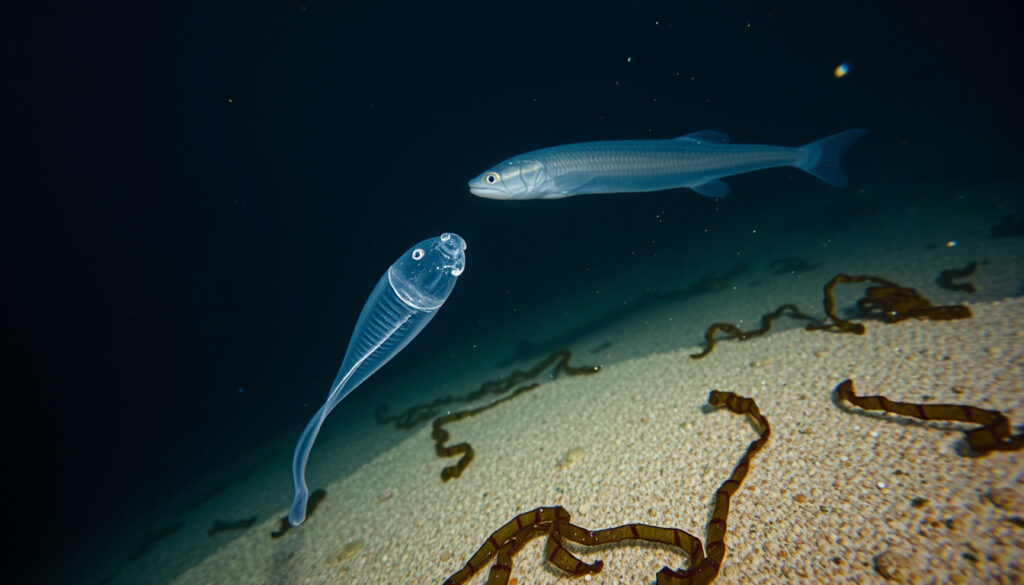
| Larval stage | Leptocephali: transparent, leaf-shaped, up to 7 cm long |
| Time to maturity | 5–20 years in freshwater before migration |
| Migration distance | Up to 5,000 km (European eel) |
| First captive larvae | Produced in 2025 at Wageningen University, Netherlands |
When did we find out how eels reproduce?
The timeline of discovery reads like a detective story spanning 2,500 years. The first chapter belongs to Aristotle, who in the 4th century BCE wrote that eels arose from mud — a guess that held for centuries because no one could find their reproductive organs.
How long did it take to find out how eels reproduce?
- 1777: Italian biologist Carlo Mondini finally discovered eel ovaries, proving they do have reproductive organs (Smithsonian Magazine).
- 1896: Two biologists identified the translucent, leaf-shaped leptocephalus larvae as eel larvae — a crucial link.
- 1922: Danish researcher Johannes Schmidt inferred the Sargasso Sea as the spawning ground by mapping larval size gradients (ScienceDirect Topics).
- 2022: The first direct evidence: satellite tags placed on 26 adult eels from the Azores tracked them to the Sargasso Sea (Nature Scientific Reports).
- 2025: Wageningen University announced they produced thousands of healthy eel larvae in captivity for the first time.
Did they ever find out how eels reproduce?
Yes — the 2022 tracking study provided the first direct proof that adult European eels reach their presumed breeding place in the Sargasso Sea. The study monitored 26 eels for 40 to 366 days and recorded swimming speeds of 3 to 12 km per day (Nature Scientific Reports). However, scientists have still not observed an actual mating event or egg-laying in the wild (Smithsonian Magazine).
Do all eels go to the Bermuda Triangle to reproduce?
A persistent myth ties eel reproduction to the Bermuda Triangle, and it’s easy to see why both involve mysterious disappearances and the Sargasso Sea. But the connection is accidental.
Is it true that eels mate in the Bermuda Triangle?
- No. Eels spawn in the Sargasso Sea, which is east of the Bahamas and well south of the Bermuda Triangle.
- The Sargasso Sea is bounded by the North Atlantic Gyre, not by the Bermuda Triangle’s vertices near Miami, Bermuda, and Puerto Rico.
- The confusion likely arose because the Sargasso Sea is a region of still water and floating seaweed where ships once got stuck — the same hazard zone that partly inspired the Bermuda Triangle legend.
What is the actual spawning location of eels?
Larval surveys consistently show the smallest European eel leptocephali occur in a broad swath of the Sargasso Sea between latitudes 20°N–30°N and longitudes 50°W–70°W (PMC / Proceedings-style article). A 2019 study found recently hatched larvae as small as 12 mm (less than 20 days old) scattered across an area up to 2,000 km wide, confirming spawning occurs across an expansive region within a single season (PMC / Proceedings-style article).
The Bermuda Triangle legend gets more clicks than the Sargasso Sea ever will, but the science is clear: eels don’t disappear there — they breed there, and the larvae drift back to Europe and North America on ocean currents.
How do eels reproduce if they don’t have reproductive organs?
The short answer: they do have organs — they just hide them until the moment is right. For centuries, no one found gonads because eels only develop them during their migration to the ocean.
Do eels have reproductive organs?
Yes. Female eels have ovaries; males have testes. But these organs remain in an immature, barely visible state for 5 to 20 years while the eel lives in freshwater. Only when the eel begins its oceanic migration do the gonads mature (Smithsonian Ocean). This delayed development is what fooled Aristotle, Freud, and generations of fishermen.
Do eels reproduce asexually?
No. All evidence points to sexual reproduction with external fertilization. Eggs and sperm are released into the water column in the Sargasso Sea. There is no documentation or scientific support for parthenogenesis or other asexual methods in eels.
Why can’t eels be bred in captivity?
Despite decades of effort, no one has closed the eel’s life cycle in a tank. The core problem: eels need the hormonal signals of a 5,000 km migration to mature.
Have eels ever been bred in captivity?
Not fully. In 2025, researchers at Wageningen University reported a major milestone: “All our eels mature and we manage to get 75 percent of the females to lay eggs which produce thousands of healthy larvae” (Wageningen University (aquaculture research)). Yet the larvae still need to be fed and raised to adult stage — something that has never been achieved.
What are the obstacles to captive eel reproduction?
- Eels require a long migration and specific hormonal triggers that are nearly impossible to replicate in tanks.
- In captivity, they often fail to initiate sexual maturation at all.
- Even when larvae are produced, they need a diet of wild plankton that is difficult to sustain artificially.
Wageningen’s 2025 success proves that inducing egg production is possible — but the gap between larvae and a self-sustaining captive population is still vast. For the global eel farming industry, which relies on wild-caught juveniles, the financial stake is enormous.
How do freshwater eels reproduce?
Freshwater eels, such as the European and American species, are catadromous: they live most of their lives in rivers and lakes but must swim to the ocean to spawn. This is the opposite of salmon (anadromous).
Do freshwater eels migrate to saltwater to reproduce?
Yes. After spending 5–20 years in freshwater, adult eels undergo physical changes — their eyes enlarge, their skin turns silver, and their digestive system shuts down — before beginning a one-way journey to the Sargasso Sea. They stop eating and rely entirely on stored fat to fuel the 5,000 km swim (Smithsonian Ocean).
What is the difference between freshwater and saltwater eel reproduction?
| Feature | Freshwater eels (Anguilla spp.) | Saltwater eels (e.g., morays, congers) |
|---|---|---|
| Habitat | Freshwater rivers, lakes as adults | Entirely marine |
| Migration | Catadromous: swim to ocean to spawn | No major habitat shift |
| Spawning area | Sargasso Sea (Atlantic) | Localized deep-sea sites |
| Larval stage | Leptocephali drift on currents for months to a year | Shorter larval period |
| Post-spawning fate | Adults die | Some species survive |
The pattern: freshwater eels invest everything in a single, fatal spawning run, while marine species may have more flexible life histories.
Timeline: The 2,500-Year Search for Eel Reproduction
| Date | Event |
|---|---|
| 4th century BCE | Aristotle writes that eels arise from mud without reproduction |
| 1777 | Carlo Mondini discovers eel ovaries, proving they have reproductive organs |
| 1896 | Two biologists identify leptocephalus larvae as eel larvae |
| 1922 | Johannes Schmidt discovers Sargasso Sea as spawning ground (inferred from larval sizes) |
| 2022 | First adult eel with mature gonads found in Sargasso Sea via satellite tags (Nature Scientific Reports) |
| 2025 | Wageningen University produces thousands of eel larvae in captivity (Wageningen University (aquaculture research)) |
The implication: each milestone took centuries to reach, yet the final pieces — direct observation of mating and a closed captive cycle — remain tantalizingly close.
What’s known and what’s still unclear
Confirmed facts
- Eels spawn in the Sargasso Sea (Nature Scientific Reports)
- Adult eels migrate one-way to spawning grounds and die after spawning
- Eels have gonads that remain undeveloped until migration (Smithsonian Ocean)
- Larvae (leptocephali) drift with ocean currents to freshwater habitats (PMC / Proceedings-style article)
What’s unclear
- Exact spawning behavior (timing, specific sites, social structure) is not fully known
- Why eels cannot be bred in captivity despite advances
- The precise trigger for sexual maturation during migration
- Whether all eel species follow the same reproduction pattern
Voices from the field
All our eels mature and we manage to get 75 percent of the females to lay eggs which produce thousands of healthy larvae.
— Researcher at Wageningen University, 2025 (Wageningen University (aquaculture research))
Born in the Sargasso Sea, in the central Atlantic, they hatch into transparent larvae that look like leaves with tiny fish heads stuck on.
— BBC Science Focus (BBC Science Focus (popular science magazine))
It lasted thousands of years and puzzled Aristotle and Freud.
— Discover Wildlife (Discover Wildlife (natural history publication))
The road ahead for eel research
The 2022 tracking breakthrough turned a 2,500-year-old mystery into a solvable puzzle, but the final piece — witnessing an actual eel mating event — remains elusive. For the global aquaculture industry, the 2025 captive larvae success offers hope, but the full life cycle in a tank is still years away. For the European eel, which is critically endangered, the urgency is clear: either we protect the Sargasso Sea corridor and replicate its conditions in captivity, or one of nature’s great migrations could vanish before we fully understand it. The species’ fate now depends on researchers closing that last observational gap.
Related reading: What Causes High Triglycerides? · What Causes Pancreatic Cancer?
conservationbytes.com, pmc.ncbi.nlm.nih.gov, youtube.com, nature.com, reddit.com, pubmed.ncbi.nlm.nih.gov, sargassoseacommission.org
The 2022 breakthrough finally solved the 2,500-year-old riddle of eel reproduction, confirming their Sargasso Sea spawning grounds in the Sargasso Sea.
Frequently asked questions
Do eels reproduce in freshwater or saltwater?
Freshwater eels (Anguilla spp.) reproduce in saltwater — specifically the Sargasso Sea. They migrate from rivers to the ocean to spawn.
How long do eels live before reproducing?
Eels typically spend 5 to 20 years in freshwater before migrating to the Sargasso Sea to reproduce.
What is the Sargasso Sea?
The Sargasso Sea is a region in the central North Atlantic Ocean bounded by ocean currents. It is known for its floating Sargassum seaweed and is the only sea without land boundaries.
Why were eels thought to have no reproductive organs?
Because eels’ gonads remain tiny and undeveloped until they begin their oceanic migration. Early dissectors simply couldn’t find them.
How do eel larvae travel to freshwater rivers?
Leptocephali drift with the Gulf Stream and other currents for months to up to a year, then metamorphose into glass eels that enter estuaries and swim upstream.
Can eels reproduce in home aquariums?
No. The migration distance and hormonal triggers required have never been replicated in captivity. Even large research facilities struggle to induce maturation.
What is the difference between European and American eel reproduction?
Both species spawn in the Sargasso Sea but their larvae drift to different continents — European eels toward Europe, American eels toward North America. They are closely related but genetically distinct.
How does climate change affect eel reproduction?
Warmer ocean temperatures may alter currents that carry larvae to freshwater habitats. Changes in the Gulf Stream could reduce recruitment of glass eels to European rivers, further endangering the species.
More related posts
 United States Milano Cortina 2026: Team USA Guide & Bans
 What Is a Green Card? Definition, Requirements, Costs, Process
 When to Use Semicolon – Rules, Examples, Common Mistakes
 Social Security COLA 2024: 3.2%, Plus 2025 and 2026 Rates
 Is The Unbearable Weight of Massive Talent Worth Watching
 Matrix Movies in Order: Watch Guide
 Calories in an Apple: Nutrition Facts and Benefits
