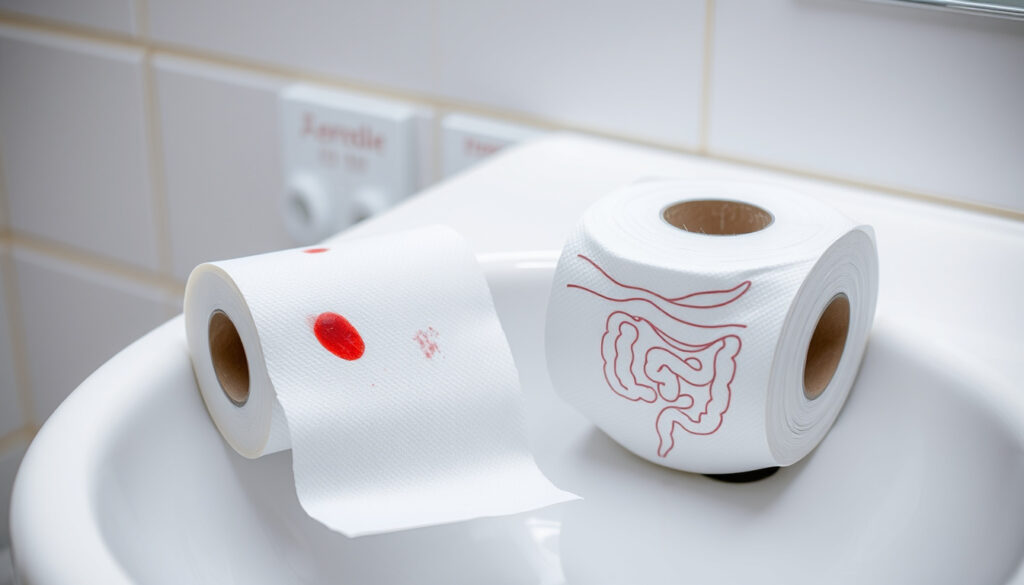
Blood When I Wipe But Not in Stool: Causes & When to Worry
That spot of bright red blood on toilet paper can spark immediate worry, but the context matters. Blood that appears only when you wipe and not mixed into the stool usually points to a source close to the anus — often hemorrhoids or a small fissure.
Lifetime risk of hemorrhoids: Up to 75% ·
Rectal bleeding due to colorectal cancer: Less than 5% ·
Documented causes of rectal bleeding: 11 (per Medical News Today) ·
Typical blood color from hemorrhoids: Bright red
Quick snapshot
- Hemorrhoids (most frequent) (Jefferson Health)
- Anal fissures (MD Anderson Cancer Center)
- Infections (STIs, proctitis) (Jefferson Health)
- Polyps or diverticula (Colorectal Cancer Alliance)
- Dark or tarry stools (Houston Methodist)
- Blood mixed in stool (Colorectal Cancer Alliance)
- Unexplained weight loss (Keck Medicine of USC)
- Persistent changes in bowel habits (Colorectal Cancer Alliance)
- Bleeding lasts more than a few days (MD Anderson Cancer Center)
- You feel weak or dizzy (Keck Medicine of USC)
- Family history of colon cancer (American Cancer Society)
- You are over 45 without recent screening (USPSTF)
- Self-care with fiber and hydration (Bayfront Health)
- Schedule GP if bleeding persists (MD Anderson Cancer Center)
- Consider colonoscopy screening at 45+ (American Cancer Society)
- Emergency if heavy bleeding or dizziness (Keck Medicine of USC)
The table below summarizes the key indicators to differentiate bleeding sources.
| Factor | Details |
|---|---|
| Color indicator | Bright red blood on paper usually means lower anal/rectal source. |
| Most common cause | Hemorrhoids are responsible for up to 75% of cases (Keck Medicine of USC). |
| Cancer risk | Fewer than 5% of people with rectal bleeding have colorectal cancer (MD Anderson Cancer Center). |
| Self-care first step | Increase fiber and water intake; avoid straining (Bayfront Health). |
Why is there blood when I wipe but not in my poop?
Common causes of bright red blood on toilet paper
- Hemorrhoids — swollen veins in the anal canal that rupture during wiping. They affect about half of adults by age 50 (Keck Medicine of USC).
- Anal fissures — small tears in the anal lining, often with sharp pain during bowel movements (MD Anderson Cancer Center).
- Infections or inflammation — proctitis, STIs, or inflammatory bowel disease can produce blood on the paper (Colorectal Cancer Alliance).
- Polyps or diverticula — benign growths or pouches can bleed intermittently (Colorectal Cancer Alliance).
If the blood is bright red and only on the paper, the odds tilt heavily toward hemorrhoids or a fissure — not cancer. But a single episode doesn’t settle the question; persistence is the real signal.
When is bleeding considered normal?
Occasional spotting from a known cause — like straining after constipation or a healed fissure — is typically not alarming. MD Anderson Cancer Center advises that bleeding that stops on its own and doesn’t recur is usually harmless. However, any recurrent bleeding without an obvious trigger should be evaluated.
What this means: The absence of blood in the stool is a strong clue. Blood on paper alone suggests a low (anal) source, while blood mixed in points higher up the colon.
How to tell the difference between hemorrhoid bleeding and colon bleeding?
Color and consistency differences
- Hemorrhoid blood: Bright red, often coats toilet paper or the surface of stool (Jefferson Health).
- Colon cancer blood: Dark red, maroon, or black/tarry; mixed into the stool; can occur without a bowel movement (Houston Methodist).
One contrast, two patterns: the color of the blood and whether it’s on the paper or in the bowl tells you the likely source.
| Feature | Hemorrhoid Bleeding | Colon Cancer Bleeding |
|---|---|---|
| Blood color | Bright red | Dark red, maroon, or black |
| Location of blood | On toilet paper / coats stool | Mixed inside stool |
| Pain during BM | Often present (fissure) or mild | Usually absent |
| Timing relative to BM | During or just after | Can occur at any time |
| Associated symptoms | Itching, prolapse | Weight loss, fatigue, change in bowel habits |
Other symptoms of colon cancer
Keck Medicine of USC points to signs like persistent abdominal pain, a feeling that the bowel doesn’t empty, unexplained weight loss, and fatigue. If any of these accompany rectal bleeding, the risk profile rises.
When to consult a doctor
Any bleeding that persists beyond a few days, or that’s accompanied by a change in bowel habits, warrants a visit. MD Anderson Cancer Center stresses that rectal bleeding should never be assumed to be hemorrhoids without evaluation if it is unexplained, persistent, or recurrent.
The catch: Many early colorectal cancers cause no symptoms at all. That’s why screening starting at age 45 — even without symptoms — is the standard.
Step-by-step self-assessment
- Check the color of the blood: bright red vs. dark/maroon/black.
- See where the blood appears: on the paper only, or mixed into the stool.
- Note any pain during bowel movements (common with fissures).
- Consider risk factors: age over 45, family history of colon cancer, unexplained weight loss.
- If bleeding persists more than a few days or you have any warning signs, schedule a doctor visit.
At what stage does a hemorrhoid bleed and when should you worry?
Stages of hemorrhoids
- Stage 1: Internal hemorrhoids bulge into the canal but don’t prolapse; bleeding is the most common sign (Bayfront Health).
- Stage 2: Prolapse with bowel movement but reduce on their own; bleeding continues.
- Stage 3: Prolapse that requires manual reduction; bleeding less common.
- Stage 4: Irreducible prolapse; bleeding is rare.
If your bleeding is accompanied by dark blood, unintended weight loss, or a family history of colorectal cancer, don’t assume hemorrhoids. Those red flags demand a colonoscopy regardless of stage.
Warning signs that warrant medical attention
Keck Medicine of USC lists alarming signs: persistent bleeding despite home treatment, blood mixed in the stool, dark/tarry stools, unintended weight loss, and any bowel habit change lasting more than two weeks. If you are 45 or older and haven’t had a screening colonoscopy, schedule one even without symptoms.
The pattern: Bright red blood on the paper with a known trigger (constipation, pregnancy) is low risk. Dark blood or bleeding without a bowel movement is not.
What treatments are available for blood when I wipe?
Home remedies
- Increase dietary fiber to 25–30 grams per day (Bayfront Health).
- Drink at least 8 glasses of water daily to soften stool.
- Avoid straining during bowel movements.
- Use sitz baths (warm water soaks) for 10–15 minutes after each BM.
- Apply over-the-counter hemorrhoid creams or suppositories.
Medical treatments for hemorrhoids
For persistent or severe hemorrhoids, options include rubber band ligation, sclerotherapy, coagulation, or hemorrhoidectomy. Jefferson Health notes that these are office-based or short procedures. If bleeding is due to a fissure, topical nitroglycerin or calcium channel blockers can help.
When to seek emergency care
Go to the emergency department if you have heavy bleeding (soaking through toilet paper more than once), feel lightheaded or dizzy, or have severe abdominal or rectal pain. Keck Medicine of USC underscores that any bleeding causing weakness or fainting is a medical emergency.
Most people with blood on the paper never need a procedure — fiber and hydration resolve it. But the 5% who do have a more serious cause benefit from early detection, which turns a curable condition into a manageable one.
Pros of home remedies
- Low cost, no side effects
- Effective for mild hemorrhoid bleeding
- Safe to try for 1–2 weeks
Cons of home remedies
- May not resolve severe or recurrent bleeding
- If due to cancer, delays diagnosis
- No substitute for colonoscopy when indicated
What percentage of blood in stools is cancerous?
Statistical risk estimates
Fewer than 5% of people who experience rectal bleeding are diagnosed with colorectal cancer (MD Anderson Cancer Center). The vast majority — over 90% according to Colorectal Cancer Alliance — have benign causes like hemorrhoids, fissures, or diverticular disease.
Factors that increase risk
- Age: Risk rises after 50; screening is recommended from 45 (American Cancer Society).
- Family history: A first-degree relative with colorectal cancer doubles your risk.
- Inflammatory bowel disease: Crohn’s or ulcerative colitis increase cancer risk.
- Lifestyle: Smoking, heavy alcohol use, obesity, and a low-fiber diet are associated with higher rates (Bayfront Health).
For the 95 out of 100 people whose bleeding is benign, reassurance is the main treatment. For the remaining 5, a screening colonoscopy can catch cancer early enough to cure it. That’s why the decision to scope hinges on risk factors, not just the presence of blood.
Confirmed vs. Unclear: what we know
Confirmed facts
- Hemorrhoids cause bright red blood on wiping (Jefferson Health).
- Anal fissures cause bright red blood with pain during bowel movements (MD Anderson Cancer Center).
- Colon cancer can cause dark or maroon blood mixed in stool (Houston Methodist).
What’s unclear
- Exact percentage of rectal bleeding cases due to cancer varies by age and geography (American Cancer Society notes regional differences).
- Home fecal occult blood tests have moderate sensitivity and may miss some cancers (Keck Medicine of USC).
- The exact prevalence of hemorrhoids across populations is not precisely known, though estimates range from 50–75% in adults.
“Rectal bleeding is not something to ignore, but it’s not always a sign of cancer.”
— MD Anderson Cancer Center
“A small amount of bleeding from the bottom that happens once is not usually a serious problem.”
For anyone seeing blood on the paper, the decision is clear: use the color and timing clues to gauge urgency, but if the bleeding persists or comes with risk factors, a colonoscopy is the definitive next step. For the 5% who need it, it can be life-saving.
Related reading: **What Causes Pancreatic Cancer? Risk Factors & Early Signs**
To better understand what different blood colors mean, you can check our detailed guide on bleeding from the back passage.
Frequently asked questions
Can stress cause blood when I wipe?
Stress alone does not directly cause rectal bleeding. However, stress can lead to constipation or diarrhea, which can trigger hemorrhoids or fissures that bleed.
Is blood after wiping always hemorrhoids?
No. Other causes include anal fissures, infections, polyps, diverticula, and rarely colorectal cancer. A persistent or repeated episode should be evaluated.
Can colon cancer cause blood only when wiping?
Unlikely in early stages, but possible. Cancer-related bleeding often occurs without a bowel movement and may be dark. Blood only on the paper is more typical of a low anal source (Houston Methodist).
What does blood from hemorrhoids look like compared to cancer?
Hemorrhoid blood is bright red and coats the paper or stool surface. Cancer-related blood is often dark red, maroon, or black, and may be mixed into the stool (Colorectal Cancer Alliance).
Should I go to the emergency room for blood on toilet paper?
Not usually. If the blood is a few drops on the paper and you feel fine, a GP appointment is fine. Go to the ER if bleeding is heavy, you feel dizzy, or have severe pain (Keck Medicine of USC).
How long does hemorrhoid bleeding typically last?
Usually a few days to a week with home care. If it persists longer than a week despite dietary changes and over-the-counter treatments, see a doctor.
Can I treat rectal bleeding at home?
For occasional bleeding from known hemorrhoids or fissures, yes — increase fiber, hydrate, use sitz baths, and avoid straining. If bleeding persists or is accompanied by other symptoms, medical evaluation is needed.
When should I schedule a colonoscopy for bleeding?
If you are 45 or older and haven’t had a screening, schedule one regardless. Also if bleeding persists, you have a family history of colorectal cancer, or you notice dark blood, weight loss, or bowel habit changes (USPSTF).
More related posts
 Bed Bug Bite Symptoms: Identification and Treatment Guide
 United States Milano Cortina 2026: Team USA Guide & Bans
 Houses for Rent Near Me: Cheap Rural Ireland Options
 Atletico Madrid vs Real Madrid Lineups: Injuries & Where to Watch
 Average Height for Men: US, World, and Percentiles
 In the Heights Movie Cast: Actors, Roles & Broadway Origins
 Signs Probiotics Are Working – How to Know They’re Effective
